Latest Movie :
Recent Movies
Showing posts with label academic. Show all posts

Why Male Orgasm is Different From Ejaculation (NSFW)


Orgasm October is over and Naked November has come and past. Now, Dick & Dildo December is in full swing! We posted some time ago about how to have multiple orgasms for men that raised a good question among our readers. Specifically, one reader noted [of the article], "Seems they just redefine what an orgasm is for men, and go on just to talk about control." Actually, no. Ejaculation and orgasm aren't the same. Today, we're talking about how they're different.

Brendan debunks any misconceptions you appreciated readers may have about about male orgasms and ejaculation! With lots of research, we have some answers to your perplexing question. This is just part two in our series of the male orgasm, so stay tuned for more articles to come. GetLusty's Brendan White reports.  

* * *

For many men, orgasms and ejaculation are inextricably combined because ejaculation and orgasms seem to happen at the same time.  While this is the often the case, ejaculation and orgasms don't necessarily have to happen at the same time - and don't with a great deal of men.  Both words refer to two separate events that have some associated causes and effects.  Think of a Venn diagram - there are aspects of each category that are mutual and aspects that are completely separate.   

Fleshing out the difference

Before we can dive headlong into the nitty gritty details of male orgasms and ejaculation, it's critical to define the two terms.  The exact definition of an orgasm is heavily contested.  Some clinical definitions are limited to physiology while others extend into the realms of psychology and neurology.  There are rigid definitions that see an orgasm as predominantly physiological: muscular contractions involved during sexual activity, along with changes in heart rate, blood pressure and other factors.  I've also encountered sources that claim orgasms are completely mental while ejaculation is the physical end of things.  While nicely compartmentalizing the two terms, this claim is false!

Orgasm

I believe the most useful definition of an orgasm is somewhere out there in orgasm no-man's land - as a mental state, as a series of physiological and also neurological events.  During an orgasm, brain waves change and certain hormones are released.  Scientific American reports: "Achieving orgasm, brain imaging studies show, involves more than heightened arousal. 

It requires a release of inhibitions engineered by shutdown of the brain’s center of vigilance in both sexes and a widespread neural power failure in females."  Orgasms are controlled by the autonomic nervous system, which operates below the level of consciousness and is responsible for other things like heart rate, digestion, respiratory rate, sexual arousal, and more.  This system, when stimulated enough, triggers an orgasm, which in turn queues ejaculation.

Ejaculation

The definition of ejaculation, on the other hand, is far less ambiguous.  Ejaculation is the strictly physical process of ejecting semen from the male reproductory tract.  If you're still skeptical consider this: some men ejaculate before orgasms, some after.  Some men may not ejaculate at all when they orgasm.  It is not uncommon for orgasms from prostate stimulation to be dry and ejaculate-less.  There are also retrograde ejaculations which occur when semen is redirected to the urinary bladder.  Retrograde ejaculations can be one symptom of a larger medical problem so if you think you are having retrograde ejaculations, do yourself a favor and talk to your doctor.

Conclusion

So lets go over what we uncovered today!  Orgasms are total body responses while ejaculations are more isolated physical events.  While the two can in some cases be mutually exclusive, typically an ejaculation follows an orgasm.   Don't be confused - they are different from each other!  Don't you let anyone tell you differently, just point them to GetLusty for Couples for some proper sex indoctrination.

This is an article by our newly titled Business Outreach intern, Brendan White. Brendan is a Boston University graduate with a passion for all things historical and also all things sex. A recent Boston transplant to Chicago, Brendan has a musical mind and at one point toured the country. When he's not thinking about conquering feudal Japan, chances are he's playing loud Rock N' Roll somewhere with other like minded individuals. When he is not thinking about GetLusty, he's spending time with his exceptionally lovely girlfriend.

 Want to get in touch with Brendan? E-mail him at Brendan@getlusty.com.

3 Must-Read Books on Blowjobs

This Dick & Dildo December, we're talking about... well the phallus. Now is the time for thought of blowjobs, too! Ah, blowjobs. They keep a man's world spinning. For ladies on the giving end, pleasing is a noble job, but it can be hard (pun intended) and help is sometimes needed. We always have recommendations, and here we're offering our favorites on blowjob books! Our Crimson Love Reports!

* * *

For many people, blowjobs are difficult, misunderstood and embarrassing. If you're a beginner it can be hard to find a starting point and even the seasoned professional can find the one eyed monster intimidating. Do not fear! There is plenty of literature out there and we have found a few great blowjob books to aid you in your quest.
#1 Passionista: The Empowered Woman's Guide to Pleasuring a Man
Harper Collins Publishers, 2008
Author: Ian Kerner (also author of "She Comes First")

Written with the same witty, insightful, and readable voice that has made, "She Comes First" and, "Be Honest—You're Not That Into Him, Either." The popular 'Passionista' is the empowered woman's guide to enjoying sex to the fullest—and ensuring that he does too.  

Ian Kerner is a man and is obviously writing from a male perspective. But, what better way to learn how to please a man than by learning from a man? That being said, Kerner is solidly feminist and works to encourage his female readers.  

This book is incredibly detailed and delves further into other important aspects like male sexuality in relation to what he wants and craves. This book will surly be one you love and your guy will love you for reading it.

#2 Tickle His Pickle

Tickle Kitty Press, 2004
Author: Dr. Sadie Allison

Dr. Sadie Allison has been a leading authority on sexuality for over a decade with around 2 million books sold. Her bestselling titles include Tickle His Pickle, TOYGASMS!, Ride 'Em Cowgirl!, Tickle Your Fancy, and the new Tickle My Tush. Each has won the much coveted IPPY—Independent Publisher’s Best Sexuality Book Award.

Tickle His Pickle comes complete with suggestions on how to incorporate sex toys, more than 50 different techniques, and ways that your blowjob can fulfill his deepest fantasies.

This book is women-friendly and it won't make you feel silly for picking it up and seeking the help.  The book has received a great deal of praise and the reviews are mostly positive.  Even Adam Carolla liked it!

#3 The Ultimate Guide To Fellatio 
Cleis Press, 2002
Author: Violet Blue

The great thing about this book is that it is for both beginner and expert level blowjobbers. Violet writes in a straightforward and friendly manner. She aims to dispel many common myths and misunderstandings. The reader is reminded that the giver has as much access to pleasure as the receiver.

The book also focuses on important technical aspects like shaving, and how to add pleasure with things like anal play. Simple, easy-to-follow illustrations are also included. At the same time, the book reads more like a frank discussion between friends than a text book.

Throughout, Violet maintains a playful tone that helps to make light of a task that would otherwise be daunting. Her book focuses more on helping beginners, yet still fun for everyone.

With love from, GetLusty!

This is a guest post by our very own Crimson Love. Crimson is our resident BDSM and fetish lover. If you don't see Crimson out dining with her adoring boyfriend, you'll find her reading books on innovation or finance. Crimson is currently finishing off her Bachelor's degree and loves talking about thinks like innovation. She is passionate about food, photography, music and especially sex. Of course, she's not afraid to talk about it. With everyone!

Have story ideas? Get in touch with Crimson at amber@getlusty.com


The History of Blowjob: Why It's So Popular

This summary is not available. Please click here to view the post.

The Psychology of BDSM


What's BDSM all about? Where does it come from? Maybe you are confused as to why people engage in such activities or don't get why people do it. Sure, Fifty Shades of Grey put a face to the acronym. But BDSM been existed way before Christian Grey was flogging Anastasia Steele. Even though the book "normalizes" what used to be an unconventional sexual practice, many are still confused as to why people do it, or if they are even normal — whatever that means.

Clarisse Thorn, a pro-BDSM, sex positive writer is here to dive into the historical and psychological aspect of BDSM. It is about time we educated ourselves on BDSM and see why it's really just a fabulous sexual outlet for couples, vanilla or kinky.

* * *

BDSM is a 6-for-4 deal of an acronym: Bondage, Discipline, Dominance, Submission, Sadism and Masochism. It's sometimes referred to as S&M, B&D, leather, or fetish. As an S&M writer and educator, I get lots of questions about the psychology of S&M. People ask whether it's a disorder, how psychologists would describe it, etc. I'm an advocate, not a psychologist, but I've read up on the history and done my best to keep tabs on current research.

First things first: S&M is not a pathology, and all people who practice S&M are not "damaged" in some way. There aren't many S&M studies, but in 2008, this conclusion was supported by a large and well-designed survey that reached 20,000 people. The survey was done by public health researchers at the University of New South Wales in Australia, and it found that S&Mers "were no more likely [than non-S&Mers] to have been coerced into sexual activity and were not significantly more likely to be unhappy or anxious." Another recent study found that consensual S&M usually increases intimacy for a couple.

I'd like to note briefly that people have told me about using consensual, intimate, trusting S&M activities in order to work through previous non-consensual, abusive experiences that they'd had. There's nothing wrong with that. Indeed, the psychologist Peggy Kleinplatz once published a scholarly article called "Learning From Extraordinary Lovers: Lessons From The Edge," which discusses how therapists can help their clients by studying alternative sexualities. Kleinplatz included a case study of a couple whose S&M experiences helped them process and deal with past abuse.

Still, as the 2008 Australia survey shows us, most people don't practice S&M because they've been abused or because they're unhappy. People who practice S&M have the same record of unhappiness and abusive history as non-S&M people. Yet S&M was first described as a disorder in 1886, when a doctor named Richard Krafft-Ebing published the manual Psychopathia Sexualis. This landmark tome hauled many sexual practices into the light, then attempted to categorize them. Of course, the doctor's ideas hewed close to contemporary mainstream ideas of what was acceptable, and so he thought that basically everything was a disorder -- including, for example, homosexuality.

It's interesting to imagine what our mental health paradigm might be if Psychopathia Sexualis had never existed. It had a huge influence on psychiatry. Later, the psychiatric establishment began publishing a text called the Diagnostic and Statistical Manual of Mental Disorders, or DSM. The DSM doesn't specialize in sexuality, but it includes quite a lot of it. The first edition of the DSM came out in 1952; it's currently undergoing its fifth revision, and the proposed new language can be found at the DSM-5 website.

Like Psychopathia Sexualis, the original DSM called homosexuality a disorder. This changed in 1973, partly in response to gay activists. But subsequent versions of the DSM are still criticized for many reasons. Our cultural diagnoses of mental illness are shaped by lots of people with very different motives, and truth is hard to find. A 2010 New Yorker article by Louis Menand outlined many critiques of the DSM, such as the allegation that today's psychiatry "is creating ever more expansive criteria for mental illness that end up labelling as sick people who are just different." Naturally, the medical establishment has an incentive to do this, since it makes money selling treatments for illness, and more illness means more treatment.

S&M is currently in the DSM (heh, you see what I did there?). My understanding, however, is that S&M occupies a strange space within the much-edited manual. S&M is no longer listed as all-disorder-all-the-time, though it once was. But if a person has an urge towards S&M, and that person feels unhappy about it, then it is classified as a disorder. In other words, an S&Mer is labeled "healthy" if she's happy about S&M, and "unhealthy" if she's unhappy about it.

Actually, this is basically the spot that homosexuality occupied for a while. And the reason homosexuality was taken out is the same reason S&M should be taken out: because a person who wants a completely consensual type of sexuality, and who is unhappy about it, is probably better off working to change the unhappiness rather than the sexuality. Like homosexuality, S&M is stigmatized and misunderstood. A person who is stigmatized and misunderstood is likely to be unhappy, but that doesn't mean there's something wrong with her.

Within the S&M community, we have ways of working around this problem. Some people are campaigning to change the DSM directly. Others are more indirect. Years ago, the activist Race Bannon made a handwritten list of doctors and lawyers who were S&M-friendly, and began passing it around to his friends. Names were quickly added to Bannon's list, and when the Internet became popular, the list migrated online. Now, the Kink Aware Professionals list is enormous and includes profession categories from accounting to web design -- not just doctors. When I was going through my own complicated and difficult S&M coming-out process, I was lucky enough to find the list. My S&M-friendly therapist talked me through my anxiety and socially-created disgust, rather than diagnosing me with a spurious "disorder."

There's a great organization called the Community-Academic Consortium of Research on Alternative Sexualities; one of their projects is an annual conference to sensitize psychologists and therapists to the needs of alternative sexuality communities. In my home city of Chicago, there's a project based at DePaul University that seeks to change the representation of S&M in human sexuality textbooks. The Kink Representation Outreach Project involves talking to different S&Mers about their actual experience (what an idea!) and getting their recommendations about how these texts might better represent S&M. And finally, if you want some idea of the sparse and scattershot research that's been done on S&M, the blog Kink Research Overviews is a good place to start.

Within the S&M community, there's some talk of S&M as its own "sexual orientation." I have mixed feelings about this, and I've written about those mixed feelings. I think it can sometimes be helpful, but I'd rather move to a paradigm where we encourage people to see any consensual sexual act as awesome, rather than talking like "orientation" is what legitimizes sexuality. Nothing legitimizes sex except consent.

Originally posted at Clarisse Thorn's blog found here.


 Clarisse Thorn is a feminist S&M writer who has lectured from Berlin to San Francisco, and written from The Guardian to Jezebel. She wrote a book about men, dating, and sex called Confessions of a Pickup Artist Chaser; she's also got a best-of collection called The S&M Feminist. She's always writing something new, so check out her list of books.

5 Yoga Poses For Better Sex

Yoga for sex. Yes, we were surprised, too. Breathing, flexibility and strengthening exercises is how yoga can help you improve your sex life. Enjoy new positions you never thought you would be able to do. Our resident yogini and staff writer Lora Swarts is here to talk about how you can use yoga to have better sex. Read on!

* * *

Yoga is something I am extremely passionate about. I've been practicing yoga exclusively for almost two years, and I even teach yoga part-time. What began as just exercise has become so much more — I now practice yoga because it gives me mental clarity.

Since practicing yoga, I have become less stressed, more confident, and physically and emotionally stronger. With benefits like increased strength, flexibility and weight-loss, yoga is an all-around winner! When you feel more confident, have better stamina and flexibility, naturally you will want to have more sex and and better sex. Here are 5 yoga poses to help improve your sex life! Note: some of these poses may not be suitable for pregnant women. Our Lora Swarts reports.

In this series on yoga for better sex, I am here with 5 poses that will definitely rev up your sex life! Remember to consciously breath in every pose and use modifications when necessary.

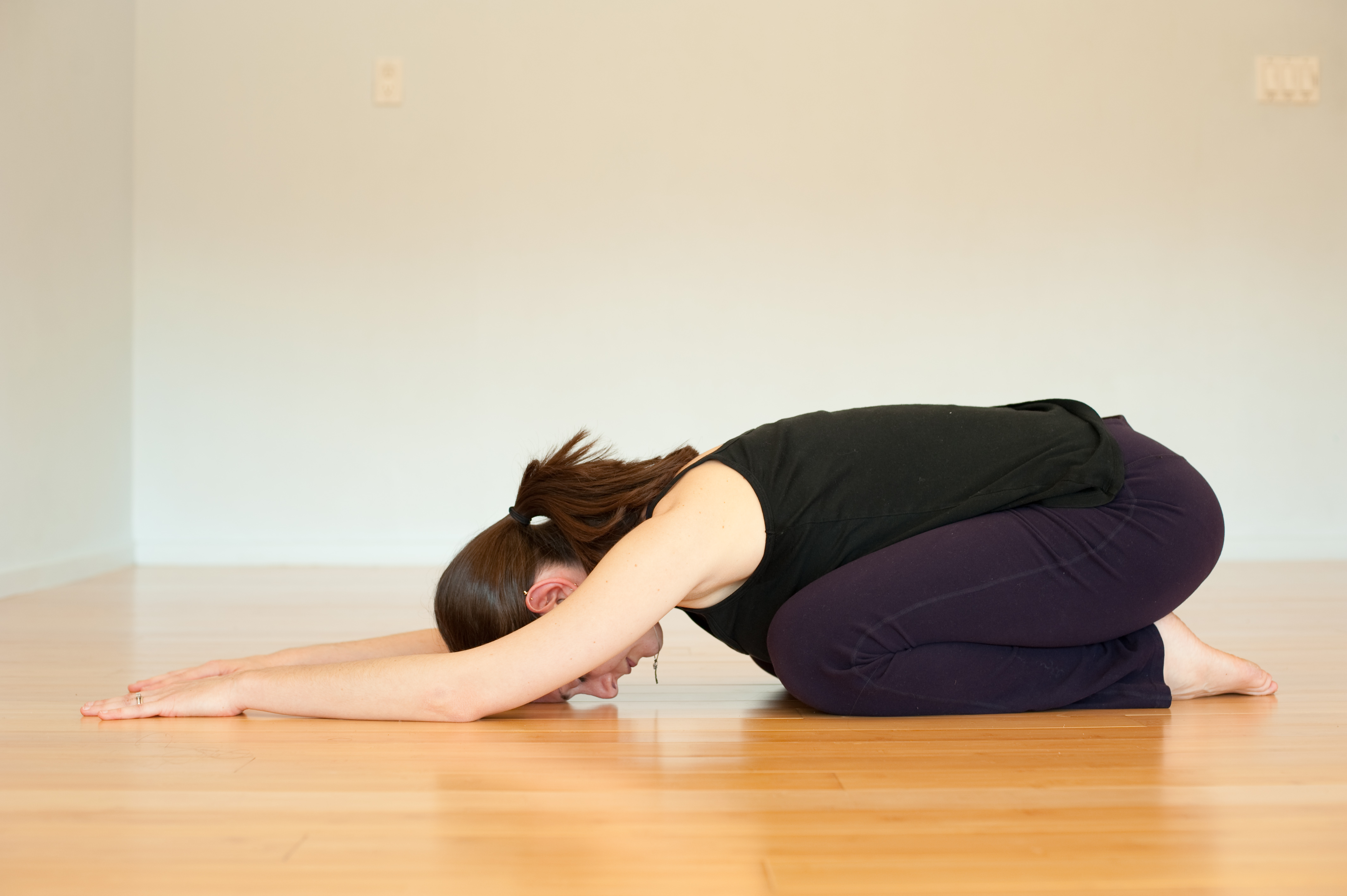
#1 Balasana (Child's pose)

This pose is great for relaxing and drawing inward. This pose will help you focus, relax and draw you into the present moment (which is always great pre-sexy time). Balasana gently stretches the hips, thighs and ankles. Rest in this pose for a few minutes.

After this pose you will definitely feel refreshed and more in tune with your breath, which equates to feeling more sensual.

How to do child's pose: kneel on your mat. Bring your big toes to touch and sit back onto your heels. Separate your knees as wide as your yoga mat or as wide as your hips. Lay your torso down in between your thighs and rest your head on your mat. Reach your arms straight out in front of you with your palms facing down, or rest your arms alongside your torso, palms facing up. Allow your shoulders to release toward the floor. With every inhale, expand your rib cage and lengthen your breath. With every exhale, deflate and release any stressful thoughts or parts of your day.  Use your breath to focus and calm your mind.


#2 Ahdo Mukha Svanasana (Downward Facing Dog pose)

Downward facing dog is great for strengthening your arms and legs and stretching your shoulders, calves and hamstrings. This is a very energizing pose and can also calm your mind and relieve stress.  It is both a calming and invigorating pose, and really helps you get into the present moment. Plus, your butt is already in the air — a great "come hither" signal to your partner!

How to do downward dog: Come into a tabletop position with your knees directly under your hips and your hands under your shoulders. Spread your fingers as wide as you can. Keep your wrist creases parallel with the top of your mat. Lift your knees off the floor and begin to straighten your legs. For a bigger stretch in your hamstrings, lengthen your stance so your heels come slightly off of the mat. Keep your head between your upper arms and draw your shoulders down towards your tailbone. Press into your hands, and press back through your heels. Stay here for 1-3 minutes. As you release, drop down into child's pose.

#3 Upavistha Konasana
(Seated wide-legged forward fold)

This pose is great for your low-libido. It improves blood flow to your lower half and brings energy and vitality to your pelvic area. The more blood flowing through your veins, the higher your arousal. This pose not only calms the mind, but it helps stretch the insides and back of your legs and releases your groins.

How to do a wide-legged forward fold: If you have tight hips, sit up on a folded blanket. Open your legs wide, to form a 90 degree angle. Roll onto the front edges of your sitting bones (untuck your pelvis). Point your toes up to the sky and activate your feet. Find a tall spine and breath into your low belly. With a elongated spine, fold forward from your hip joints. With every exhale fold a little bit deeper. Rest your head on a block for support or if you can, fold all the way forward to the floor. Stay in this pose for 1-3 minutes. When you are ready to come out, gently rise up with a long spine and draw your legs together.

#4 Garudasana (Eagle pose)

This is one sexy pose and is even in the Kama Sutra. This snake-like posture builds strength, detoxes, and builds confidence all in one! In this pose you wrap one leg around the other like a rope, and once you release your limbs, all the blood rushes through your cervix! This pose really gets you ready and in the mood.

How to do eagle pose: Stand upright with your feet firmly planted into the floor. Lift your left leg and balance on your right foot. Wrap your leg leg around your right thigh and then wrap your left foot around your right calf. Stretch your arms out in front of you, parallel to the mat and spread your scapulas wide across your back. Cross your left arm under your right, so that your right arm is on top of your left. Then, cross your wrists so your palms are facing each other. Bring your hands to touch, lift your elbows up and reach your finger to the sky. Stay here up to 30 seconds. Unleash your grip and repeat for the same amount of time on the opposite arm and leg.

#5 Bridge pose

We all know by now why Kegel exercises are important. They tone and strengthen your vagina and pelvic floor muscles as well as improve orgasms. Bridge pose is like doing a Kegel because you are squeezing the same pelvic muscles. Bridge pose also increases metabolism! It's definitely a win-win pose.

How to do Bridge pose: Lie on your back with your feet hip distance apart and flat on the floor. Reach down with your fingertips and see if you can touch your heels. If not, wiggle your feet closer to your buttocks until your fingers graze the back of your heels. Press into your feet, and lift your hips up to the ceiling. Try and clasp your hands underneath you, grab your ankles or lay your palms pressing face down on the mat beside you. Draw your shoulder blades together. Hold up to 1 minute. To release from this pose, slowly lower yourself one vertebrae at a time. Come to rest on your back, separate your feet mat-width apart, and bring your knees in to touch. This will release your low back.

Thank you Yoga Journal for some great information on these poses.

Lora is a GetLusty staff writer and our resident health nut. When she is not writing or editing, you can find her on her yoga mat, exploring Chicago via bicycle, or hanging out with her wonderful boyfriend and Beagle puppy in their north side apartment. She has a habit of spending too much money on soy lattes and yoga clothes. Find her on Twitter @HoneyNutLo or writing at her own blog. Have any questions? Email her at Lora@getlusty.com!

Putting the Fun in Feminism

At GetLusty, we love feminism because it puts us on equal footing professionally. When searching for "feminism" on shutterstock, one of the first images found is below. GetLusty's  Lynn Olejniczak reports.

* * *

Raise your hand if when you hear the word “feminism” part of you goes into a coma. Yeah, me too. First, visions of bra- burning, turtleneck wearing women from the ‘70’s start organizing marches across my brain. Then heavily tattooed lesbians sing Ani DiFranco songs. They begin screaming about men raping the environment, and everything goes black. In reality, this has all and nothing to do with Feminism. But let’s not turn this into a lecture! Let’s put the “fun” back into Feminism! And pick up a few credit hours on the way.

True or False

Q: In Medieval Europe married women enjoyed more rights than unmarried women.

False. Unmarried adolescent girls and widows were able to own property and enter into business in the private sector. It was only when they married that women gave up their rights, merging with their husband, and losing power to his gain. Granted, we’re talking nobility here, and noble women married earlier. Class and economics have been around since the earth cooled. But once the husband kicked the bucket, the widow was able to re-enter the business sphere and generally stayed a widow.

So, what can we take away from this? It sucked being a poor woman in medieval Europe? Sure. But even 600-1000 years ago women saw the difference between their rights as an individual, and their rights in marriage.

Feminism is defined as “the advocacy of women’s rights on the grounds of political, social, and economic equality to men.” The word “feminism” wasn’t coined until the 1800’s but the concept has been around much longer than that. Life during European, Roman, Greek, Islamic wartime is tough. The winners survive, and make the rules. Mostly men fought, killed, and got to make those rules. If going into labor was revered as much as killing people I doubt the word Feminism would even exist.

Women gain freedom in childbirth

Ding-ding-ding. True, well sort of. Before pregnancy was considered a medical condition, and only doctors (read: men) could deliver babies, you called the midwife. When a woman became a midwife, she was granted the freedom of tending to the laboring mother. The midwife is the one with the “freedom.” She enjoyed certain amount of time away from the household, she received some respect and even power in the community. Unfortunately, when overseeing a magical act of a delivery gone wrong the midwives were often accused of witchcraft.

A large part of feminist rhetoric is aimed at a woman’s right over her own body. Reproductive and contraceptive rights were obviously in the forefront of this year’s elections. The definition of rape and the results thereafter were also at great debate. Men and women loudly voiced their opinions proving that one doesn’t have to be a woman to believe a woman has rights over her own body. But Feminism isn’t only about the sexual rights of women. It can include the rights of the LGBT community, a stand on pornography (both for and against), opinions on prostitution and trafficking. It concerns a woman’s health rights, and rights regarding sexual harassment and abuse. Feminism does not have to include man:bad, woman:good any more than religion has to include fire and brimstone. But just like radical religious zealots there are radical feminists. Unfortunately when most people hear the word “feminist” they envision the radical, woman-only type.

78 year old feminist, Gloria Steinem has retired

False. OK, that was a lay-up. At the 40th anniversary of Ms. Magazine, Steinem made a very insightful point. She said, “...All great social justice movements must last something like a century if they are to be really deeply absorbed into the culture and understood to be normal and natural.”

The Industrial Age (1750-1850) eventually led to the fight for workers’ rights. The current attitude of the majority is that workers are entitled to proper pay for proper work, time off, enforcement of child labor laws, and safe working conditions. Unfortunately, this fight still takes place but usually because people try to skirt the laws that were established to uphold what was believed to be normal and natural. Women’s rights, civil rights, LGBT rights are still considered young movements in comparison. 

Feminism today is generally more inclusive. Color, nationality, religion, and class encompass the push for equal representation for women. Recent electoral history proves there are still examples of laws oppressing women. But Feminism today is not only about the law. It's about changing the thought process that says men have superiority over women (read: equality). It challenges the notion that women don’t know enough to govern their bodies. It urges recognition of the influence of women in art, literature, music and architecture without encouraging separation.

The hurdle we must get over in understanding Feminism is not assuming that women are fighting to usurp power but to be included in it: equally. But if Gloria is right, we still have another 60 years before we are close.

Class dismissed.

One organization GetLusty has supported in the past is WORD: Women Organized to Resist and Defend. They're a liberal organization that here in Chicago, nationally and international have organized grassroots protests in support of women's reproductive rights. They're pretty awesome and completely volunteer run (only starting mid-2012, they've done quite a bit so far).

Speaking of feminist sex, have you 'Liked' GetLusty on Facebook yet? We're giving away a Tiani 2 to a lucky 'Liker' by December 1st. We're also on Pinterest and Tumblr, as well as Twitter @getlusty. What?! You're on those platforms and aren't in tune with our awesome content? Have amazing sex. Get lusty.

Lynn Olejniczak is a native Chicagoan who loves her city and everything it has to offer. She spent 10 years as a NASDAQ trader in Chicago and New York in the 90's, then went back to college when "the rules changed and I realized no one was going to pay me lots of money to swear at them anymore."

She loves good food, and a perfectly poured Guinness at any Irish pub in the city. Her Beastie Boys CD's rest comfortably next to her Misfits vinyl, and she believes Underground Garage is the best radio program known to humankind. Armed with degrees in History, and a love of Urban Planning, Lynn is currently writing and researching a book on the 80's Chicago bar scene. Get in touch with Lynn at editorial@getlusty.com.

6 Things You Didn’t Know About Cunnilingus

This summary is not available. Please click here to view the post.

10 Lesbian Stereotypes Debunked


Though we're interested in featuring articles for gay and lesbian audiences, we've just started creating lesbian-focused content. We're glad, though, that lesbian, gay and straight relationships are relatively similar. In the second article in a series focused on lesbian-issues, we're offering several stereotypes that need debunking. What do straight individuals think about lesbians that just isn't necessarily true? GetLusty's lesbian writer Milan Weasley reports.

* * *

There are stereotypes for many people and lifestyles. Lesbians are no different. GetLusty's Milan Weasley is here to lay bare (pun intended) these myths. And open the mysterious world of lesbians to the readers of GetLusty!

#1 Lesbians hate men

Being a lesbian does not mean that we hate all humans with penises. Some of my closest friends are male. I can even acknowledge seeing an attractive man. But do I want to have sex with him? No. And being a lesbian means just that. Lesbians are fine working with and even befriending men. We just don't want you guys in our beds.

#2 Lesbians just haven't the one

Not every lesbian is a gold-star. Meaning some lesbians have never slept with a man, but some have. Just like some people are only attracted to blondes, some women are only attracted to women. I like to explain it like this, the worst sexual experience I had with a woman was still better than the best sexual experience I had with a man.

#3 Why do you use toys then?

Toys spice up every relationship. They add something new and fun. There are lots of lesbians that don't like or use toys. There are many positions that don't require toys, not just limited to cunnilingus and scissoring! And yes, some lesbians do scissor.


#4 Lesbians wish they were men

Some lesbians have more masculine traits. Do they want to transition to the opposite sex? Not all the time. Lesbians are women that like other women. While transgender people are individuals born biologically into one body, but feeling as if another sex fits them. Not all lesbians identify as trans*, but some do.

#5 All lesbians are feminist

Not all feminists are lesbians. And not all lesbians are feminists! We honestly aren't that different. There isn't a list of attributes all straight women must abide by, and the same applies to lesbians. We're all different. There are women that are anti-feminist, as there lesbians that are the same. We're not all bra burning. Lesbians are against bras for a very different reason.

#6 There's gotta be a butch

Lesbian relationships are just that. A relationship between two lesbians. If one was the man, it'd be a heterosexual relationship. Although some lesbians have a more masculine appearance, it does not mean they adhere to all masculine traits. In some straight couples, the woman works while the man stays at home. It doesn't make him any more the woman in the relationship than it makes her the man.

#7 I can spot a lesbian!

We don't come with tags. And throughout different countries and cultures, styles are different. Not all lesbians wear plaid and look like lumberjacks. Not all of us have short pixie cuts. I've mentioned that lesbians have a plethora of personalities, and the same applies to looks. Because of this, some lesbians have to come out repeatedly. I've come out to other lesbians and gotten looks of shock.

#8 Lesbians choose their sexuality.

It's unnatural. Did you know many species of animals, in nature and in captivity, engage in homosexual pairings. The Bonobo chimpanzee, the species most biologically similar to humans, are almost exclusively bisexual in nature and captivity. Bottlenose dolphins have homosexual relationships and sex, often in pairs for life. If it can develop in animals, naturally, why is it so incomprehensible that it can also be natural with us?

#9 Lesbians 'like' every woman

Again, just like every straight man isn't attracted to every woman, every lesbian isn't attracted to every woman. Everyone has types and interests. Don't fear ladies! If lesbian starts a conversation with you, it's not guaranteed to end with her hitting on you. We don't want to recruit you. I don't plan on hazing any straight women into the lesbian society.

#10 Lesbians don't have 'real' sex!

You can have sex without a penis. Think of it this way, when women masturbate, they aren't using penises. But it's still considered sex. And if they are using toys, it's still sex without a penis! Dildos are not replacements for penises.

This is the second in a series of posts from GetLusty staff writer Milan Weasley.

Milan Weasley is one of our first lesbian writers. (Ah! Dykes and dildos!) She spends her days procrastinating grad school and her nights procrastinating everything else. She enjoys writing, gogo dancing, sewing, pole dancing, and defending the Oxford comma.

Questions, comments or article ideas? Get in touch with Milan at milan@getlusty.com.

Be a Sexy Vixen. Learn It From Bettie Page!

This summary is not available. Please click here to view the post.
Copyright © 2011. Country Girl City Life - All Rights Reserved
Proudly powered by Blogger